A good breakroom starts with a simple question: what do people need while they are on your property? For one Lakeland office, the answer may be cold drinks and a few reliable snacks. For a warehouse with several shifts, it may include breakfast, filling food, coffee, and a way to buy everything when nearby restaurants are closed. Choosing equipment before answering that question can leave you with an impressive setup that employees rarely use.
This guide helps business owners, office managers, property managers, and operations teams compare vending machines, micro markets, and related services. You will learn what information to collect, what a provider should explain, and how to judge the first month of service. The goal is a useful everyday amenity with clear responsibilities, realistic costs, and a product selection that fits your Lakeland workplace.
1. Start with your location and daily traffic
Lakeland serves a mix of employers. The Lakeland Economic Development Council’s employer directory includes healthcare, logistics, and other industries. Those workplaces can have very different breakroom needs. A clinic may want a quiet staff amenity, while a distribution facility may need enough capacity for several groups taking breaks close together. The same headcount does not automatically call for the same equipment.
Count the people who are actually on site each day, rather than the total number on payroll. Separate employees, regular contractors, residents, and visitors where relevant. Then record how many people are present during each shift. A business with sixty employees spread across hybrid schedules may have less daily demand than a smaller facility where everyone works on site. Share the busiest break periods, too, because average traffic can hide short queues.
Look at access to alternatives. Can employees walk to food, bring meals, use a kitchen, or leave easily during breaks? Do they pass through security when returning? You do not need to discourage outside trips to make vending useful. You need to understand the situations in which convenient snacks, drinks, or food would solve a real problem. A short staff survey often provides better guidance than assumptions made from the office.
2. Compare vending machines and micro markets
Traditional vending keeps products inside a machine until a customer pays. A snack machine, beverage machine, or combination unit can be a practical starting point when space is limited or the business wants a controlled product display. Customers choose from the available selections, pay, and receive their item. Ask which payment methods the proposed equipment supports, because readers and features vary between machines.
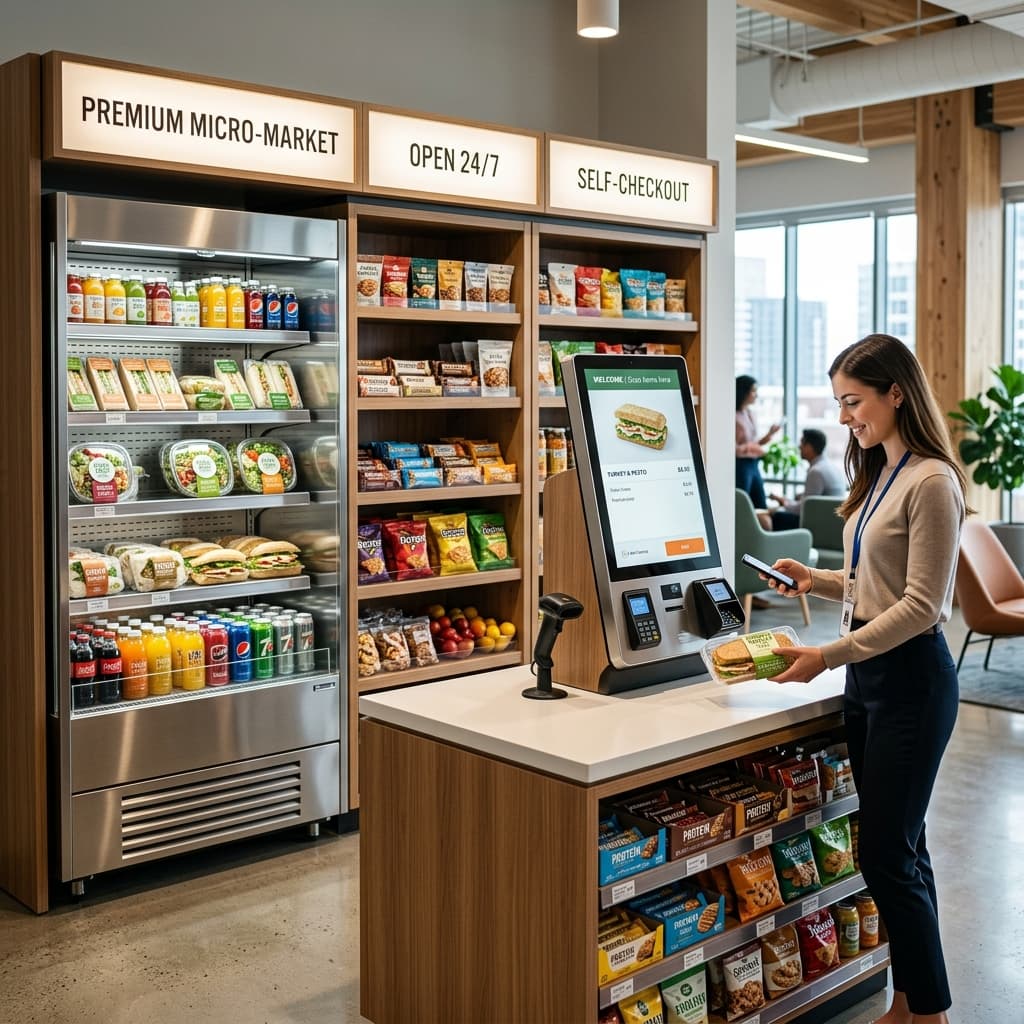
A micro market uses open shelving, refrigerated displays, and a checkout system. It can offer a wider assortment, including packaged meals where the operator supports them. That flexibility also means the site needs suitable space, a clear checkout process, and an agreed approach to access and inventory control. It is generally better suited to a defined workplace community than an unrestricted public passageway.
Neither format is automatically better. A small staff room may work well with one combination machine. A larger employee breakroom may support separate snack and beverage units or a micro market. The decision should consider actual demand, available space, service access, and the provider’s ability to maintain the assortment. Ask for a recommendation with reasons, rather than a proposal based only on the biggest installation available.
3. Understand what free vending means
When a provider offers free vending machine placement, it commonly means the business does not buy the machine or pay a separate installation charge for an approved location. Employees and visitors still pay for the items they purchase. The operator uses product sales to support stocking, equipment, and service. Approval depends on the provider’s assessment of the location, so free placement should be confirmed in writing.
Your business may still supply floor space, electricity, and reasonable access for deliveries. A proposed setup might also need connectivity or site preparation. Ask who handles those requirements and whether any charge applies before agreeing. Clarify whether the operator owns the equipment, how removal works, and whether the agreement includes a minimum term. A clear proposal should make responsibilities easy to understand without relying on a verbal promise.
Coffee, water, pantry programs, and employer-funded products can have different billing arrangements. Do not assume every breakroom service is included in a no-cost vending placement. If your business wants to subsidize snacks or provide complimentary coffee, request a separate explanation of equipment, supplies, and recurring charges. Compare proposals using the same scope so an attractive headline does not obscure a different product or service package.
4. Plan for shifts and break periods
For a workplace operating beyond standard office hours, ask what employees can buy at the beginning, middle, and end of each shift. Early arrivals may want breakfast snacks and coffee. Later teams may need a filling option when food businesses nearby are closed. This is a planning exercise, not a promise that one specific menu works for every warehouse. Confirm preferences with representatives from each shift before launch.
Restocking should account for consumption between visits. If the most popular drinks sell out after the first break period, the answer may be additional capacity, a different assortment, or a revised service schedule. Ask whether the equipment supports remote sales or inventory monitoring and what the operator actually does with those signals. Monitoring is useful only when it leads to an appropriate response, so discuss the practical service process.
Access matters just as much as scheduling. A driver may need a badge, an escort, a loading entrance, or a delivery appointment. Give the provider your access rules early and name a backup contact. If the facility has seasonal peaks, overtime periods, or holiday changes, explain those patterns. Establish how much notice the operator needs to adjust supply so shift leaders do not become the last-minute coordinators of the breakroom.
5. Choose products people will purchase
Begin with a balanced assortment rather than a long wish list. Familiar chips, crackers, bars, and sweets can sit alongside products employees request with different preferences. For drinks, consider water, familiar soft drinks, and lower-sugar choices where there is demand. The useful question is whether people have options they like at prices they understand. A product mix that looks impressive but sells slowly will be difficult to sustain.
Use the first few weeks to learn. Ask the provider how employees can request items and when the selection will be reviewed. One enthusiastic request does not necessarily justify an entire row, but repeated requests may reveal a gap. Agree on a reasonable way to try new products, check sales, and replace slow sellers. A small, dependable selection is often a better starting point than unnecessary variety.
For dietary preferences, encourage customers to check the manufacturer’s packaging and ingredient information. Product placement or a healthy-options label does not establish that an item is suitable for a specific allergy or dietary requirement. If your facility has product restrictions, communicate them before installation and document the agreed selection process. The provider should explain what it can reliably support rather than making a broad guarantee about every product.
6. Check space, power, and delivery access
Before equipment arrives, measure the proposed area and the route used to reach it. Include doorways, elevators, tight turns, and any thresholds. The footprint on a brochure is only part of the space requirement: staff need room to open doors, load products, clean, and work on equipment. Ask for the actual dimensions and clearance requirements of the units being proposed, then review the location together.
Confirm electrical needs with the provider and your facilities contact. Avoid assuming that an available outlet is suitable for every refrigerated unit or that an extension cord is an acceptable installation plan. Ask about ventilation, nearby heat sources, lighting, and connectivity requirements. These details can affect placement and service reliability. Resolve them before setting an installation date so the delivery does not become an expensive exercise in moving furniture twice.
Keep the area easy to approach and separate from busy vehicle or equipment routes. In a shared breakroom, consider how people queue, open refrigerators, use microwaves, and walk to seating. The proposed layout should work during the busiest break, not just when the room is empty. Have your facilities team review the plan against the building’s requirements, and ask the operator to explain how customers reach the controls and checkout.
7. Ask about service and refunds
A vending proposal should explain what happens after installation. Who restocks the equipment? How are repair requests made? What information should employees provide when an item does not dispense? Ask for a contact method that is visible at the machine or checkout. A customer should not have to search the internet or find an office manager to report a small purchase problem.
Discuss refunds before the first sale. Confirm what payment details are needed, how the customer submits a request, and how the operator communicates the outcome. Avoid collecting unnecessary personal or payment information through an informal staff spreadsheet. If a machine has a cashless reader, ask whether support handles reader problems as well as mechanical faults. Knowing the distinction can prevent a report from being passed between different contacts.
Repair response and resolution are different. A provider may acknowledge a ticket quickly while parts or access affect the repair date. Ask how urgent problems are prioritized and what communication you receive during an outage. If you need a particular service commitment, put it in the agreement. A realistic process with a named contact is more useful than an unsupported promise that every issue will be fixed within a few hours.
8. Add coffee or water when it fits
Office coffee service can complement vending, but begin with usage. Estimate how many people drink coffee, which times are busiest, and whether visitors also use the equipment. Ask who buys consumables, who cleans the brewer, and how supplies are replenished. Cups, lids, creamers, and filters are small details individually, yet missing any of them can make an otherwise suitable coffee setup frustrating to use.
Discuss the balance between variety and upkeep. A compact brewer may meet the needs of a small team. A larger workplace may prefer equipment with more capacity or drink choices, but additional features can require more cleaning and supplies. Request a demonstration of the routine tasks your staff would perform. Choose a system the site can support consistently, rather than judging only the menu displayed on the front.
For water filtration, ask about installation needs, filter replacement, service access, and billing. Keep drinking-water planning distinct from optional beverage purchases in vending machines. If the business is evaluating coffee, water, and snacks together, request itemized options. That makes it easier to introduce one service first and expand later without misunderstanding which supplies or maintenance tasks are included in the original arrangement.
9. Use a practical proposal checklist
Gather the same information for each operator you compare. Describe your location, working hours, daily headcount, available space, and preferred services. Include photographs or measurements if the provider requests them through an appropriate channel. A proposal based on a real site review is more useful than a generic package. Do not change the scope between comparisons unless you also account for that difference when making the decision.
Ask each provider to explain equipment ownership, installation responsibilities, eligibility for no-cost placement, product pricing, payment methods, stocking frequency, and support procedures. Then cover contract length, cancellation, removal, damage responsibilities, and changes if traffic falls. Keep the written answers with the agreement. This is not about creating a complicated procurement exercise; it is about avoiding questions that become harder to resolve once equipment is already installed.
Evaluate service fit alongside equipment. A provider needs to reach your location during permitted delivery windows and support the products your staff use. For sites in Winter Haven, Bartow, Auburndale, or Plant City, ask specifically about service coverage and scheduling. A website listing a city is a starting point for discussion, not proof of a particular response time. Confirm the details for your exact address.
10. Review the first thirty days
Launch with a simple communication plan. Tell employees where the equipment is, how to pay, how to report problems, and how to suggest products. Explain that items are purchased individually unless the company has arranged a subsidy. Make the operator’s contact information visible and give your internal coordinator a copy of the service agreement. Clear expectations help the amenity settle into everyday use without creating unnecessary questions.
After the first month, review what people actually use. Ask which items sell well, which run out, and which remain untouched. Check whether queues are manageable and whether night or weekend teams have the same access as daytime staff. Invite specific feedback rather than asking only whether employees like the installation. A comment about a missing breakfast option or a confusing reader is easier to act on than a general complaint.
Agree on the next adjustments with the provider. That could mean rotating a few products, changing capacity, improving signs, or revisiting stocking times. Keep the review proportionate to the size of the installation. There is no need to promise that vending will transform retention or productivity to justify a useful breakroom. Reliable access, clear support, and products people choose are concrete outcomes you can observe and improve.
Common questions from Lakeland businesses
Can a small office qualify for free vending?
Possibly, but there is no universal headcount rule. Daily attendance, expected purchases, available space, and route fit all matter. Share your real usage pattern and request an assessment. If a no-cost placement is not suitable, ask whether a smaller format or another arrangement would work before committing to equipment.
Do customers need cash?
That depends on the installed equipment. Many modern setups support cards or mobile wallets, but you should confirm the specific reader and whether cash remains available. Ask how prices are displayed and how customers report a payment issue. Make the accepted methods clear when introducing the installation to staff.
How soon can equipment be installed?
Timing depends on approval, equipment availability, delivery access, and site readiness. Ask the provider for a written schedule after the assessment. If you are opening a facility or preparing for a busy period, share that date early. A confirmed plan is more useful than relying on a general installation estimate.
Plan your Lakeland breakroom
The strongest starting point is a short description of your workplace: address, daily attendance, shift pattern, available space, and the products people want. From there, compare equipment and service together. Confirm costs, responsibilities, support, and the process for adjusting the assortment. Whether you choose snack vending, beverage vending, or a micro market, the installation should fit the people using it every day.
Request a free Lakeland vending quote to discuss your location and preferred services. Include the approximate number of people on site and any delivery restrictions. No-cost equipment placement is subject to location approval; product purchases and optional coffee, water, or pantry services may have separate costs. A useful proposal will explain those details so you can choose the next step with confidence.